United States Senate
I Heard You Paint HousesThe United States Senate appears in I Heard You Paint Houses as both a stage for public exposure and an instrument of federal investigation. Through televised hearings on organized crime and later inquiries into alleged CIA cooperation with the Mafia, it brought hidden networks before a national audience. The book also places a limit around that power: a subpoena could demand testimony, but it could not ensure that a witness would live to give it.
Televised hearings and public exposure
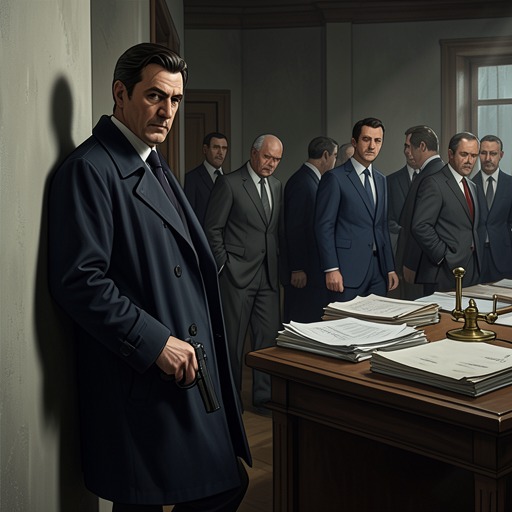
In 1957, the McClellan Committee hearings on organized crime brought mob figures into American homes through live black-and-white television. The book describes men wearing diamond pinkie rings, conferring quietly with their lawyers, then facing senators and the committee’s counsel, Robert F. Kennedy. Asked about accusations that included murder and torture, witnesses repeatedly invoked the Fifth Amendment. The familiar refusal—“Senator, on advice of counsel, I respectfully decline to answer that question on the grounds that it might tend to incriminate me.”—became, in the book’s account, a cultural refrain. Many viewers understood the repeated invocation as an admission of guilt, though the response itself was a claim of constitutional protection, not a conviction.
The televised hearings transformed the relationship between organized crime and public knowledge. The proceedings showed not only the questioning of witnesses but also their lawyers’ presence and the controlled, repeated form of their answers. The Senate’s investigative work could make a subject visible even where witnesses disclosed little. The book contrasts this new visibility with the standing of the quiet and powerful Russell Bufalino, who had been little known to the public before Apalachin and the McClellan hearings.
Inquiry, evidence, and labor racketeering
The Senate’s investigative role also formed part of the background to later prosecutions. The Test Fleet enterprise, involving a car-hauling company put in the names of Jimmy Hoffa’s wife and the late Owen Bert Brennan’s wife, had been investigated by the McClellan Committee and the Department of Justice before the 1962 trial. Prosecutors alleged that the company was part of a long-term arrangement to pay Hoffa after he settled a strike favorably for an employer that would do business with it. The book’s account distinguishes the Senate committee’s prior investigation from the trial itself: committee scrutiny contributed to the history of the allegations, while the criminal case proceeded through a separate legal process.
That distinction matters in the narrative. The Senate’s hearings assembled and broadcast allegations; they were not the same as a jury’s determination of guilt. The account places congressional investigation alongside federal prosecution, surveillance, and trial, showing several institutions pursuing overlapping questions without treating their roles or conclusions as interchangeable.
The subpoena of Sam Giancana
The United States Senate later subpoenaed Sam Giancana to testify about the CIA’s hiring of the Mafia to assassinate Fidel Castro. According to the book, Giancana was killed in his kitchen four days before he was due to appear. The account describes him being shot in the back of the head and then six times beneath the chin, a pattern it characterizes as Sicilian in style and as a warning about careless speech. It does not establish who killed him; rather, it places the murder beside the impending testimony and the danger attached to what he might have revealed.
That sequence gives the subpoena a significance beyond a routine demand for testimony. In the book’s telling, Giancana’s expected appearance connected Senate oversight to secrets involving intelligence agencies, organized crime, and political history. His death prevented the testimony, leaving the Senate’s investigative purpose entangled with the very silence it sought to penetrate.
The Church Committee and the Castro plots
The Senate Church Committee’s inquiry into CIA ties to organized crime further widened the Senate’s role in the book. In June 1975, amid the committee’s hearings, Time reported that Russell Bufalino had helped the CIA in a gangland plot against Castro. The committee concluded that Bufalino had been part of a conspiracy to use poison pills against Castro shortly before the Bay of Pigs invasion in April 1961. This is presented as a committee finding about a covert operation, not as an account of a public Senate hearing witnessing the plot itself.
The committee’s investigation also supplied a larger context for the events surrounding Giancana and Jimmy Hoffa. The book places the reporting on Bufalino’s alleged CIA role in the same period as Giancana’s killing and, a month later, Hoffa’s disappearance. The Senate’s institutional presence therefore recurs at moments when private criminal networks and secret government activity become subjects of public inquiry. Its hearings could expose connections and preserve official findings, but the narrative’s unresolved deaths and missing testimony underscore how much remained beyond the reach of public examination.